
Jump to Final Designs
Integrating a conversational agent into Beli’s system to
allow users to find occasion based recommendations.
Integrating a conversational agent into Beli’s system to
allow users to find occasion based recommendations.
Ask Beli.
Timeline:
July 2026
Timeline:
July 2026
Role:
Designer
Role:
Designer
Team:
Just me this time!
Platform:
Mobile Application
Team:
Just me this time!
Platform:
Mobile Application
Jump to Final Designs
Runthrough Demonstration of Ask Beli flow!
FINAL THOUGHTS
This project was a chance to bring my two fields together.
Cognitive science taught me that people don’t distrust AI in the abstract - they distrust unexplained decisions. Product design is where that insight actually becomes a screen someone can use. Ask Beli was my attempt to design a recommendation someone could interrogate, not just accept - because the moment a user has to wonder why a system is telling them something, trust is already gone.
Balancing the scales: design tradeoffs
01 - Trust vs. Speed
Every screen between “I have a craving” and “here’s your pick” is a chance for someone to give up. But an unchecked AI guess is worse than a slower, correct one.
The confirmation step adds friction on purpose - a misread caught before results load is cheap; a misread baked into a recommendation is expensive to a user’s trust
02 - Honesty vs. Appeal
The easiest version of this card only says nice things. The honest caveat is the line most likely to get cut under deadline pressure - and the one that matters most.
A recommendation that only flatters isn’t a recommendation, it’s an ad. Beli’s whole identity depends on not becoming one.
Translating this concept into a high-fidelity interface meant designing for a user overwhelmed by choice, not lacking it. We focused on transparency, restraint, and native familiarity - nothing here should feel bolted onto an app people already trust. The final flow doesn’t just rank restaurants; it turns scattered friend and community data into one explainable answer, delivered the way a friend would give it
Translating this concept into a high-fidelity interface meant designing for a user overwhelmed by choice, not lacking it. We focused on transparency, restraint, and native familiarity - nothing here should feel bolted onto an app people already trust. The final flow doesn’t just rank restaurants; it turns scattered friend and community data into one explainable answer, delivered the way a friend would give it
HI-FI DESIGNS
The final high-fidelity designs.
The final high-fidelity designs.
The entry point borrows Beli’s own teal and type before anyone even taps - it looks native, not new. It shows suggested prompts as well as a place to type in your own personalized font.
The entry point borrows Beli’s own teal and type before anyone even taps - it looks native, not new. It shows suggested prompts as well as a place to type in your own personalized font.
Asking Beli


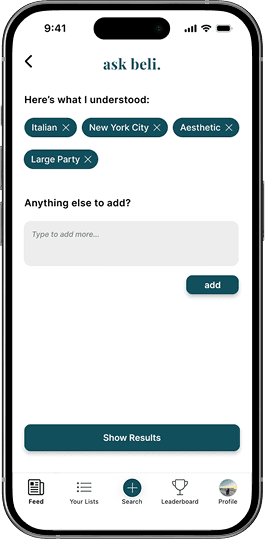

Nothing happens without a check-in - parsed intent is shown as editable tags before any results load, so any misreads gets caught. Results keep a persistent filter bar above them, so refining feels like adjusting a filter, never starting over.
Confirming and Delivering
Nothing happens without a check-in - parsed intent is shown as editable tags before any results load, so any misreads gets caught. Results keep a persistent filter bar above them, so refining feels like adjusting a filter, never starting over.

Establishing Trust
Of everything shown above, the reasoning card is where it all culminates - trust here isn’t one design decision, it’s four small ones, stacked.
01
The match score
A quick-scan confidence signal, styled after Beli’s own rating badge - not a new convention, a borrowed one.
03
Community signal
Grounded in Beli’s own tagging system, not a generic star average - always present, even with zero friend data.
04
The honest caution
The tradeoff that makes this feel like a friend’s advice, not an ad - tells you what to watch out for!
02
Friend signal
Names a specific friend and details - a reason to believe them, not just a headcount.
Maya and Jordan see the same four components - just weighted differently. Maya’s card leans on 02; Jordan’s leans on 03. Same trust system, different inputs.
Establishing Trust
Maya and Jordan see the same four components - just weighted differently. Maya’s card leans on 02; Jordan’s leans on 03. Same trust system, different inputs.

Maya Chen, 27
Maya Chen, 27
Trusts: friend rankings over public consensus
Needs: to reconcile conflicting friend opinions fast, for high-stakes occasions
Established user · 30+ friends
Established user · 30+ friends

Jordan Riley, 24
Trusts: public and community data, by necessity
Needs: the app to feel useful immediately, not after months of network-building
New to Beli · 2–3 friends
Jordan Riley, 24
Trusts: public and community data, by necessity
Needs: the app to feel useful immediately, not after months of network-building
New to Beli · 2–3 friends
WHO IT’S FOR
Multiple users, 1 system.
Multiple users, 1 system.
Those four commitments only matter if they hold up for real, different people - not just a hypothetical average user.
Those four commitments only matter if they hold up for real, different people - not just a hypothetical average user.
Based on that, I established these 4 committments that needed to be included in the Ask Beli design:
Two things came out of that research and landscape scan: people are overwhelmed by choice, and no competitor solves it with anything that knows the user personally.
01
No data gate
Public reviews are the baseline for every user - friend data enhances, never blocks.
02
Confirm before results
Parsed intent shown as editable tags, so misreads get caught early.
03
Refine in place
A persistent filter bar re-ranks live, instead of opening a new conversation thread.
04
Always explain why
Every pick shows its signal sources and an honest caveat, not just a match score.
4 things the feature had to get right.
MAIN GOAL
Multi-turn
refinement
Yelp
Assistant
OpenTable
Concierge
Ask
Beli
Explains its reasoning
Friend data weighted
Works with no friend data
Yes
Yes
Yes
Yes
Yes
Yes
Yes
No
No
No
No
Weak
COMPETITIVE LANDSCAPE
Yelp’s assistant and OpenTable’s Concierge already do conversational, occasion-aware dining search. Neither knows who you actually trust.
Yelp’s assistant and OpenTable’s Concierge already do conversational, occasion-aware dining search. Neither knows who you actually trust.
The category isn’t empty. The trust layer is.
The category isn’t empty. The trust layer is.
That tension isn’t unique to Beli. Here’s how other competitors currently handle it - and where they stop short.
That tension isn’t unique to Beli. Here’s how other competitors currently handle it - and where they stop short.
ON DECISION FATIGUE
ON DECISION FATIGUE
“Beli shows so many options, but it’s hard to choose between them.”
“Beli shows so many options, but it’s hard to choose between them.”
ON WHAT’S MISSING
“I wish there was something that could tell me where to go based on the vibes I’m feeling.”
KEY FINDING:
KEY FINDING:
Users don’t lack information on Beli - they lack a way to apply it to a specific moment. The app’s strength (depth of friend and community data) is also its friction point once the ask gets specific
Users don’t lack information on Beli - they lack a way to apply it to a specific moment. The app’s strength (depth of friend and community data) is also its friction point once the ask gets specific
RESEARCH
What current Beli users said…
What current Beli users said…
These Interviews surfaced the same tension from two directions - too much choice, and not enough guidance toward the right choice.
These Interviews surfaced the same tension from two directions - too much choice, and not enough guidance toward the right choice.
To ground that gap in something more than a hunch, I talked to current Beli users about how they actually decide where to eat.
To ground that gap in something more than a hunch, I talked to current Beli users about how they actually decide where to eat.
ON WHAT’S MISSING
“I wish there was something that could tell me where to go based on the vibes I’m feeling.”
Ask Beli lets users describe an occasion in plain language and get back a small set of recommendations, synthesized from friends, the wider Beli community, and their own taste history - and explained, not just ranked.
Ask Beli lets users describe an occasion in plain language and get back a small set of recommendations, synthesized from friends, the wider Beli community, and their own taste history - and explained, not just ranked.
Beli’s current homepage. Quick actions and browsing, no way to ask a specific question
Beli’s identity is built on social proof around food - trust comes from friends and community, not algorithms. But the app is built around browsing and ranking things you’ve already decided to look at. It doesn’t help when the ask is fuzzy and occasion-driven: a first date, a family dinner, a client meeting - situations where the right answer depends on ambiance and social stakes, not just a score.
Beli’s identity is built on social proof around food - trust comes from friends and community, not algorithms. But the app is built around browsing and ranking things you’ve already decided to look at. It doesn’t help when the ask is fuzzy and occasion-driven: a first date, a family dinner, a client meeting - situations where the right answer depends on ambiance and social stakes, not just a score.
Beli already knows the answer. It just can’t hear the question.
Beli already knows the answer. It just can’t hear the question.
Beli already knows the answer. It just can’t hear the question.
OVERVIEW

Based on that, I established these 4 committments that needed to be included in the Ask Beli design:
Two things came out of that research and landscape scan: people are overwhelmed by choice, and no competitor solves it with anything that knows the user personally.
01
No data gate
Public reviews are the baseline for every user - friend data enhances, never blocks.
02
Confirm before results
Parsed intent shown as editable tags, so misreads get caught early.
03
Refine in place
A persistent filter bar re-ranks live, instead of opening a new conversation thread.
04
Always explain why
Every pick shows its signal sources and an honest caveat, not just a match score.
4 things the feature had to get right.
MAIN GOAL
01
No data gate
Public reviews are the baseline for every user - friend data enhances, never blocks.
02
Confirm before results
Parsed intent shown as editable tags, so misreads get caught early.
03
Refine in place
A persistent filter bar re-ranks live, instead of opening a new conversation thread.
04
Always explain why
Every pick shows its signal sources and an honest caveat, not just a match score.
Maya Chen, 27
Trusts: friend rankings over public consensus
Needs: to reconcile conflicting friend opinions fast, for high-stakes occasions
Established user · 30+ friends
Runthrough Demonstration of Ask Beli flow!
FINAL THOUGHTS
This project was a chance to bring my two fields together.
Cognitive science taught me that people don’t distrust AI in the abstract - they distrust unexplained decisions. Product design is where that insight actually becomes a screen someone can use. Ask Beli was my attempt to design a recommendation someone could interrogate, not just accept - because the moment a user has to wonder why a system is telling them something, trust is already gone.
Balancing the scales: design tradeoffs
01 - Trust vs. Speed
Every screen between “I have a craving” and “here’s your pick” is a chance for someone to give up. But an unchecked AI guess is worse than a slower, correct one.
The confirmation step adds friction on purpose - a misread caught before results load is cheap; a misread baked into a recommendation is expensive to a user’s trust
02 - Honesty vs. Appeal
The easiest version of this card only says nice things. The honest caveat is the line most likely to get cut under deadline pressure - and the one that matters most.
A recommendation that only flatters isn’t a recommendation, it’s an ad. Beli’s whole identity depends on not becoming one.
This project was a chance to bring my two fields together.
Cognitive science taught me that people don’t distrust AI in the abstract - they distrust unexplained decisions. Product design is where that insight actually becomes a screen someone can use. Ask Beli was my attempt to design a recommendation someone could interrogate, not just accept - because the moment a user has to wonder why a system is telling them something, trust is already gone.