
Jump to Final Designs
Designing an application to anticipate sensory overload before your body feels it.
Designing an application to anticipate sensory overload before your body feels it.
Interra
Timeline:
Figbuild Design Sprint
Timeline:
Figbuild Design Sprint
Timeline:
Figbuild Design Sprint
Role:
Lead
Designer
Role:
Lead
Designer
Team:
Kiana Duggal
Justin Luu
Team:
Kiana Duggal, Justin Luu
Platform:
Mobile Application
Platform:
Mobile Application
Platform:
Mobile Application
Jump to Final Designs
By pairing biometric signals from a smartwatch (heart rate, breathing, movement) with live environmental data (noise, crowd density, lighting), Interra catches the early signs of sensory overload before they fully hit - then points users toward a nearby calm space or a regulation technique like box breathing or grounding, so they can reset before things escalate.
Most wellness tech only steps in once you’ve already crossed the line into overwhelm. Interra flips that timeline.
What if your device could sense overwhelm before your body does?
What if your device could sense overwhelm before your body does?
What if your device could sense overwhelm before your body does?
OVERVIEW
By pairing biometric signals from a smartwatch (heart rate, breathing, movement) with live environmental data (noise, crowd density, lighting), Interra catches the early signs of sensory overload before they fully hit - then points users toward a nearby calm space or a regulation technique like box breathing or grounding, so they can reset before things escalate.
Most wellness tech only steps in once you’ve already crossed the line into overwhelm. Interra flips that timeline.
By pairing biometric signals from a smartwatch (heart rate, breathing, movement) with live environmental data (noise, crowd density, lighting), Interra catches the early signs of sensory overload before they fully hit - then points users toward a nearby calm space or a regulation technique like box breathing or grounding, so they can reset before things escalate.
Most wellness tech only steps in once you’ve already crossed the line into overwhelm. Interra flips that timeline.
By turning sensory input and internal stress signals into something legible, the system helps users:
By turning sensory input and internal stress signals into something legible, the system helps users:
By turning sensory input and internal stress signals into something legible, the system helps users:
Our goal was a speculative tool that could detect, visualize, and help manage sensory overload as it’s happening - not after.
Our goal was a speculative tool that could detect, visualize, and help manage sensory overload as it’s happening - not after.
Our goal was a speculative tool that could detect, visualize, and help manage sensory overload as it’s happening - not after.
01
Recognize early signs their nervous system is heading toward overload
Recognize early signs their nervous system is heading toward overload
02
Understand how their surroundings are affecting them in the moment
Understand how their surroundings are affecting them in the moment
03
Access guided techniques to bring their body back to calm
04
Rebalance their sensory state before overwhelm fully sets in
03
Access guided techniques to bring their body back to calm
What we set out to build.
What we set out to build.
MAIN GOAL
04
Rebalance their sensory state before overwhelm fully sets in
15 out of 18
said their worst overload happens in loud, crowded, shared spaces.
said their worst overload happens in loud, crowded, shared spaces.
16 out of 18
said they lean on gut instinct to gauge their stress, then react to overwhelm rather than seeing it coming
said they lean on gut instinct to gauge their stress, then react to overwhelm rather than seeing it coming
14 out of 18
rated their interest at 3/5 or higher in a tool that could surface hidden sensory data about their environment.
rated their interest at 3/5 or higher in a tool that could surface hidden sensory data about their environment.
KEY FINDING:
People consistently described managing overwhelm after the fact rather than ahead of it - because they had no early signal to work from. That gap between feeling it and knowing it, before it takes over, is exactly what Interra was built to close.
People consistently described managing overwhelm after the fact rather than ahead of it - because they had no early signal to work from. That gap between feeling it and knowing it, before it takes over, is exactly what Interra was built to close.
People consistently described managing overwhelm after the fact rather than ahead of it - because they had no early signal to work from. That gap between feeling it and knowing it, before it takes over, is exactly what Interra was built to close.
RESEARCH
Why these 4 goals?
We surveyed 18 people to understand how they experience and cope with sensory overload day to day, and a clear pattern emerged: people can feel it coming, but they have no way to act on that until it’s already too late.
We surveyed 18 people to understand how they experience and cope with sensory overload day to day, and a clear pattern emerged: people can feel it coming, but they have no way to act on that until it’s already too late.
15 out of 18
said their worst overload happens in loud, crowded, shared spaces.
16 out of 18
said they lean on gut instinct to gauge their stress, then react to overwhelm rather than seeing it coming
14 out of 18
rated their interest at 3/5 or higher in a tool that could surface hidden sensory data about their environment.
Designing the interface meant designing for someone who might already be close to their limit. We prioritized clarity, breathing room, and full transparency around data - the goal was an interface that reads as a calm, trustworthy companion, not another feed of information to process.
Designing the interface meant designing for someone who might already be close to their limit. We prioritized clarity, breathing room, and full transparency around data - the goal was an interface that reads as a calm, trustworthy companion, not another feed of information to process.
Designing the interface meant designing for someone who might already be close to their limit. We prioritized clarity, breathing room, and full transparency around data - the goal was an interface that reads as a calm, trustworthy companion, not another feed of information to process.
HI-FI DESIGNS
The final high-fidelity designs.
The final high-fidelity designs.
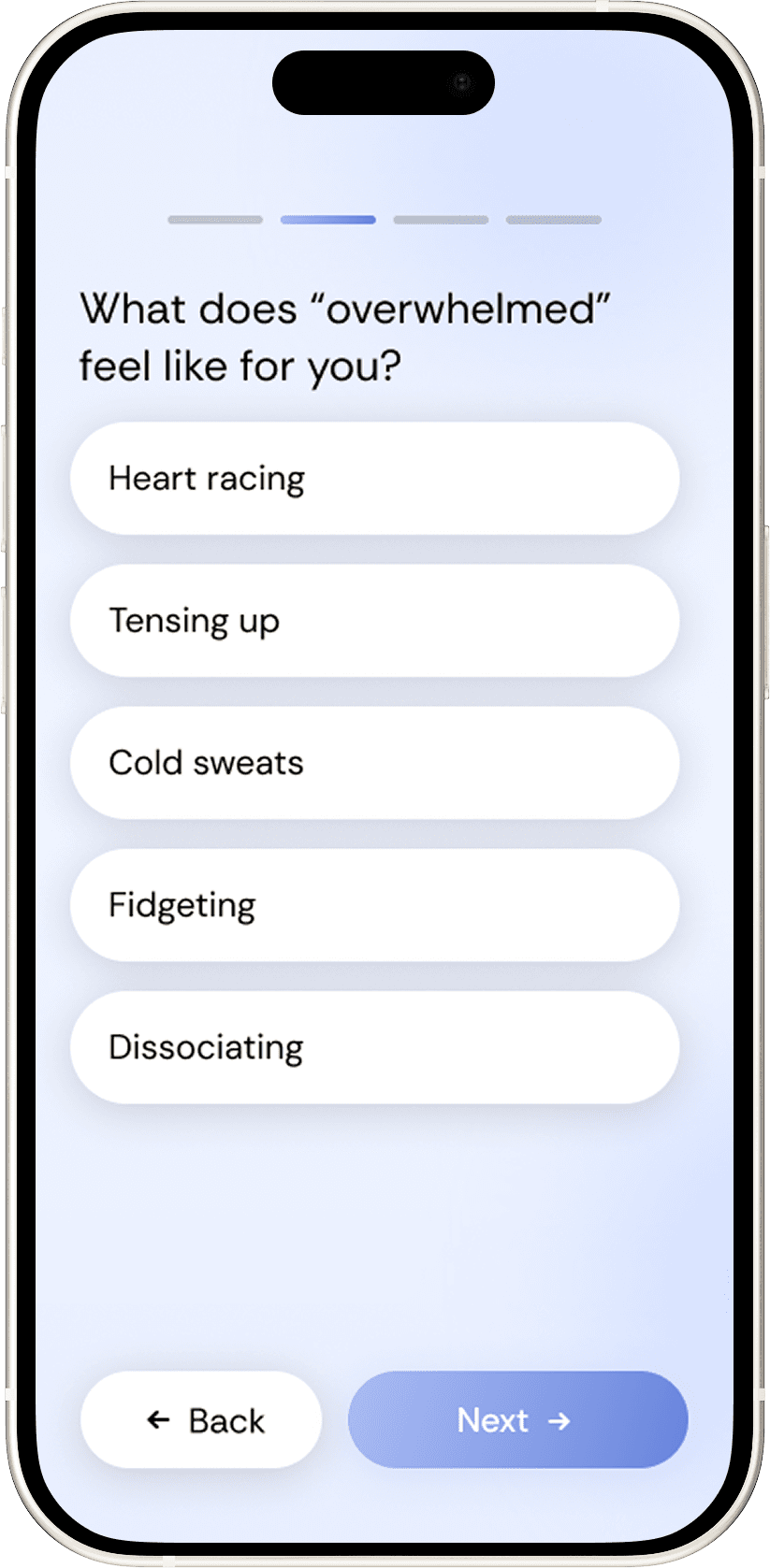
A guided setup that builds each user’s sensory profile - their specific triggers and how quickly they tend to overwhelm - while being upfront about exactly what data is collected and why.
A guided setup that builds each user’s sensory profile - their specific triggers and how quickly they tend to overwhelm - while being upfront about exactly what data is collected and why.
A guided setup that builds each user’s sensory profile - their specific triggers and how quickly they tend to overwhelm - while being upfront about exactly what data is collected and why.
A Clear Onboarding



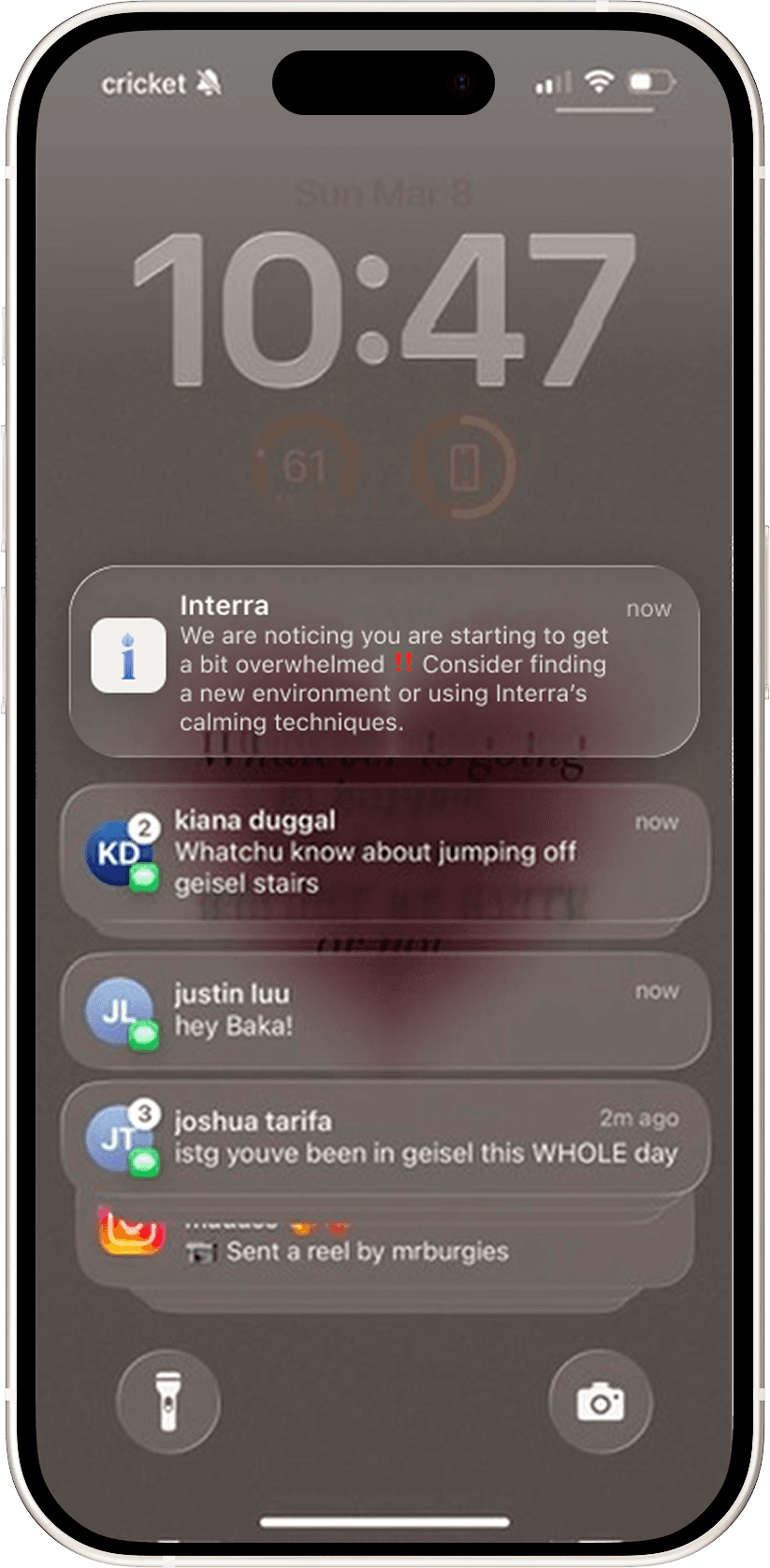

When heart rhythm spikes or movement patterns start to look like fidgeting, Interra sends a low-key notification ahead of full escalation, pointing the user toward a nearby calm space or a grounding technique.
When heart rhythm spikes or movement patterns start to look like fidgeting, Interra sends a low-key notification ahead of full escalation, pointing the user toward a nearby calm space or a grounding technique.
When heart rhythm spikes or movement patterns start to look like fidgeting, Interra sends a low-key notification ahead of full escalation, pointing the user toward a nearby calm space or a grounding technique.
Proactive Warnings


A single, uncluttered view pairing real-time body metrics (HRV, breathing, movement) with the current environment (Quiet, Calm, Bright), so users can see both sides of the picture at a glance.
A single, uncluttered view pairing real-time body metrics (HRV, breathing, movement) with the current environment (Quiet, Calm, Bright), so users can see both sides of the picture at a glance.
A single, uncluttered view pairing real-time body metrics (HRV, breathing, movement) with the current environment (Quiet, Calm, Bright), so users can see both sides of the picture at a glance.
The Real-Time Dashboard


Looking back, this project ended up being more personal than I expected going in. I notice my own version of this - situations where there’s just a lot happening at once tend to leave me overstimulated before I even understand why. Designing Interra pushed me to actually name that pattern instead of just pushing through it, and to think about what an early, gentle heads-up would have looked like if I’d had one. It reframed the whole project for me: this wasn’t just a speculative concept, it was something I’d genuinely want to use.
Runthrough Demonstration of Interra Notification flow!
Runthrough Demonstration of Interra Notification flow!
FINAL THOUGHTS
The tradeoffs we had to sit with…
The tradeoffs we had to sit with…
01 - Accuracy vs. Privacy
Richer, more continuous data collection would sharpen the tool’s insights, but our research made clear that trust depends on keeping what’s tracked to a minimum. We chose to protect that trust, even at some cost to precision.
Richer, more continuous data collection would sharpen the tool’s insights, but our research made clear that trust depends on keeping what’s tracked to a minimum. We chose to protect that trust, even at some cost to precision.
02 - Simplicity vs, Depth
We deliberately left out dense analytical charts of sensory patterns. Someone approaching a stress spike doesn’t need a complicated interface adding to the load - so we optimized for legibility over depth.
We deliberately left out dense analytical charts of sensory patterns. Someone approaching a stress spike doesn’t need a complicated interface adding to the load - so we optimized for legibility over depth.
Working within a tight timeline forced some real tradeoffs between what would be technically ideal and what would actually feel good to use:
Looking back, this project ended up being more personal than I expected going in. I notice my own version of this - situations where there’s just a lot happening at once tend to leave me overstimulated before I even understand why. Designing Interra pushed me to actually name that pattern instead of just pushing through it, and to think about what an early, gentle heads-up would have looked like if I’d had one. It reframed the whole project for me: this wasn’t just a speculative concept, it was something I’d genuinely want to use.
Looking back, this project ended up being more personal than I expected going in. I notice my own version of this - situations where there’s just a lot happening at once tend to leave me overstimulated before I even understand why. Designing Interra pushed me to actually name that pattern instead of just pushing through it, and to think about what an early, gentle heads-up would have looked like if I’d had one. It reframed the whole project for me: this wasn’t just a speculative concept, it was something I’d genuinely want to use.